We conduct research on polymer materials and technologies that enable a circular economy, resource efficiency, and sustainable product life cycles.
Customized solutions
and services
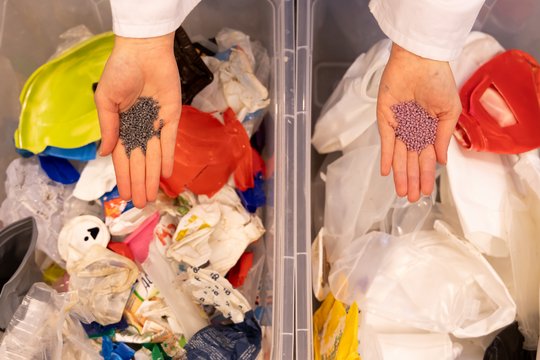
Recycling of plastics
Keeping plastics in the loop – with cutting-edge research for a sustainable future.
Our research in the field of plastic recycling focuses on the development of improved recycling systems to obtain high-quality recyclates with reliable long-term performance. Key areas include the optimization of existing sorting systems and the development of intelligent, sensor-based technologies for inline quality monitoring.
Another major focus lies in the targeted adaptation of recyclates to enhance their processing behavior and material performance. In addition, we conduct comprehensive evaluations of recyclate quality – from chemical composition to mechanical and long-term properties under realistic conditions.
An essential part of our work is also the promotion of sustainable product design through “Design for Recycling” – because circularity starts with the right material choices.
Our goal: to bring recycled plastics to the next level – functional, reliable, and ready for demanding applications with a sustainable future in mind.
Polymers in Photovoltaics
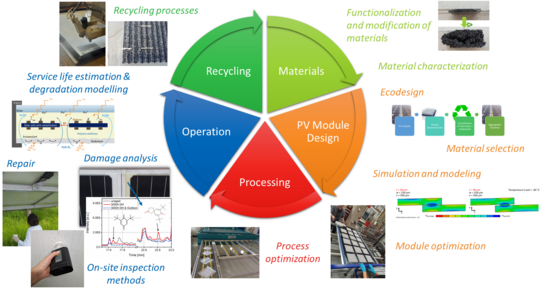
Photovoltaics research at PCCL focuses on enhancing the quality, reliability, and sustainability of PV modules.
Photovoltaics research at PCCL covers the entire value creation cycle of photovoltaics, from material science and PV module design to process optimization, performance evaluation, and reliability assessment. It also includes end-of-life management, focusing on repair and recycling strategies. The overall focus lies on enhancing the quality, reliability, and sustainability of PV technologies. Key research areas include material innovation, eco-design, process optimization, degradation modelling, and service life estimation. PCCL also works on advanced simulation methods for reliability assessment, as well as recycling technologies to improve end-of-life management. Through interdisciplinary collaboration with scientific and industry partners, PCCL contributes to the long-term efficiency and sustainability of photovoltaics.
Repair concepts for polymers
From the point of view of sustainability and resource conservation, repairable and recyclable polymers represent innovative materials for many branches of industry.
The PCCL is researching a new class of polymers - vitrimers - that have the ability to flow under temperature despite chemical network sites. This controlled change in viscoelastic properties can be used for the repair of defects, welding and recycling of a variety of technical materials such as elastomers, duromers and composite materials. Prominent examples of applications include self-healable polymers, anti-corrosive coatings and repairable composite materials for the mobility and microelectronics sectors. If the polymer material reaches the end of its life despite repair, it can be easily recycled. At defined temperatures, the network becomes mobile and can be reshaped or chemically broken down into its original components in the presence of water vapor. Current work is investigating new catalysts and reaction mechanisms that will enable this new class of polymers to be produced economically. The synthesis is complemented by comprehensive material characterization, taking into account application-relevant environmental conditions.
In addition, new eco-designs and mechanical repair concepts (including mechanical and thermal metamaterials) are being developed to enable easy disassembly, repair and recycling of multi-material composites.
Innovative Materials for Battery Cells and Systems
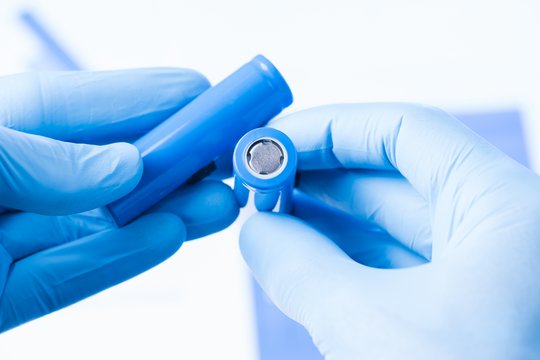
Batteries are crucial to the energy transition, as they enable electric mobility and store renewable energy from sources such as solar and wind.
However, improving their performance while ensuring operational safety remains a major challenge, as batteries are complex multi-material systems. Changes to individual components can have unexpected effects on the overall system, which often only become apparent during testing or normal operation. Polymer Competence Center Leoben GmbH (PCCL) is dedicated to solving current global challenges, with a focus on battery technology. With its interdisciplinary expertise in the development of new materials, materials engineering, computer modeling and simulation, and data science, PCCL strives to develop practical and effective strategies to improve the safety and performance of batteries. This includes the use of state-of-the-art testing equipment for the precise characterization of battery cell components, innovative virtual simulations supported by AI algorithms for the efficient prediction of thermomechanical properties with high accuracy, and the development of innovative polymer materials to improve safety, e.g., through early detection of thermal runaway and flame-retardant casings. Through these advancements, the PCCL supports battery manufacturers in developing systems that deliver outstanding performance while ensuring safety in critical situations.
Functional adhesives
PCCL develops new adhesives for the production of recyclable composite materials.
Adhesive bonding is an established joining process in industry and plays an important role in the production of composite materials. The PCCL has many years of experience in the development and characterization of adhesive formulations, the majority of which consist of cross-linkable polymers.
The focus of the research work is not only on the reliability, adhesive strength and durability of the adhesives, but also on the introduction of new functions. Adhesives for future applications should reliably bond the components over their planned service life and lose their adhesive strength in a controlled manner at the end of their life. The PCCL is researching new adhesives that lose their adhesive strength under the influence of external stimuli (e.g. temperature, electricity, magnetic field) through depolymerization and the release of gaseous decomposition products. This enables controlled disassembly and separation of materials from bonded composite materials.
In addition, adhesives are being equipped with electrical properties and new bio-based raw material sources are being evaluated. This lays an important foundation for a new generation of adhesives for the (micro)electronics industry as well as the energy and transportation sectors.
Development of bio-based resins
The production of bio-based alternatives with comparable properties to conventional petroleum-based resin systems is a core competence at PCCL.
Bio-based resins are polymeric materials made entirely or partially from renewable raw materials such as vegetable oils, starch, cellulose, lignin or other biomass sources. In contrast to petroleum-based resins, bio-based resins represent a more sustainable alternative and contribute to the reduction of greenhouse gas emissions, the CO2 footprint and dependence on fossil resources. Their use is becoming increasingly important due to rising environmental regulations, growing social demand for ecological products and the challenges of climate change. In addition to their ecological benefits, modern bio-based resins often also offer outstanding technical properties such as high mechanical strength, chemical resistance or improved processability. Some representatives can also be biodegraded or facilitate the recycling of end products and contribute to an improved circular economy.
The PCCL is researching innovative solutions so that bio-based resins can keep up with or even surpass their petroleum-based counterparts. Depending on the area of application, such as construction, the automotive industry, aviation or the packaging sector, coatings, adhesives or composite materials with an adapted property profile can be developed.
Chemical recycling for the recovery of raw materials from plastics
The PCCL is researching innovative chemical recycling strategies that make a significant contribution to a more efficient circular economy.
Chemical recycling is a method of recovering raw materials from plastics and composite materials in which the polymer chains are broken down into their reactive building blocks, monomers and oligomers, using chemical processes. In contrast to mechanical recycling, in which the plastics are merely shredded and melted, chemical recycling enables almost complete material recovery, even with heavily contaminated, mixed or complexly composed materials. This means that even cross-linked plastics and fiber-reinforced composites, which were previously difficult or impossible to recycle, can be efficiently recycled.
The most important chemical recycling processes include depolymerization based on solvolysis, as well as catalytic or enzymatic approaches. Chemical recycling is becoming increasingly important, particularly in the field of composite materials, such as glass or carbon fiber-reinforced plastics, as fibers can be separated from the matrix with virtually no damage. At the PCCL, the focus is on making this process as energy-efficient as possible by producing suitable catalyst systems on the one hand and characterizing the individual components obtained and their properties after reprocessing on the other. Chemistry and material characterization therefore work in close coordination to control and improve the entire process.
Are you ready? Request a quote
now for innovative solutions.